
Introduction: Companies across many industries depend heavily on a variety of resources to operate efficiently and maintain their competitiveness in today’s dynamic business climate. Asset lifecycle management (ALM) approaches are used by organisations to ensure optimal performance, cost effectiveness, and compliance. The influence of ALM on the automotive aftermarket will be covered in this blog article, along with how maintenance expenses can be lowered by up to 33% and downtime can be decreased by up to 23%.
What Is Asset Lifecycle Management (ALM)?
ALM is a strategic approach to managing physical assets throughout their lifecycle – from acquisition and operation to maintenance and disposal. And emphasizes maximizing value, optimizing performance, and minimizing total cost of ownership.
The Automotive Aftermarket’s Use of ALM:
The automotive aftermarket involves parts, equipment, and services purchased after the original sale of a vehicle. ALM applies to:
- Service equipment: Diagnostic tools, lifts, compressors, etc.
- Service facilities: Workshops, service bays, mobile units.
- Technician tools: Scanners, torque wrenches, etc.
Highlight challenges:
- Equipment aging
- Cost of downtime
- Pressure to deliver quick, high-quality service
- Safety and compliance
ALM Extends Asset Life:
- Predictive Maintenance: ALM helps us use data analytics, IoT, and sensors to predict failures. Reduces unplanned downtime and increases useful life.
- Scheduled Servicing and Inspections: ALM allows us to do proactive, routine checks that guarantee efficiency and compliance.
- Digital Twin & Smart Asset Management: With the help of ALM, we can create digital replicas of key assets for simulation and planning, thereby enhancing long-term decision-making.
- Data-Driven Decision Making: We can leverage usage data generated by ALM software to determine repair vs. replacement. We can then begin TCO analysis to guide investments.
Case study on how organizations benefit from Smart ALM software for Automotive Aftermarket.
An automotive company with auto repair and diagnostic centers in over 85 locations across India. The company provides services to both consumer and fleet customers, ranging from routine maintenance to advanced diagnostics and repairs.
With smart asset lifecycle management software: The business was able to see how its assets were being used. They were able to monitor idle time, utilisation rates and asset performance using real-time data from IoT sensors integrated into the apparatus.
Outcome: The company reduced downtime by 23% and maintenance costs by 33%, Asset utilization rate 60%, as proactive maintenance allowed them to address potential issues before they led to failures. This improved delivery efficiency, reduced operational disruptions and enhanced customer satisfaction.
How ALM helps optimize the lifecycle of aftermarket parts and tools in automotive services.
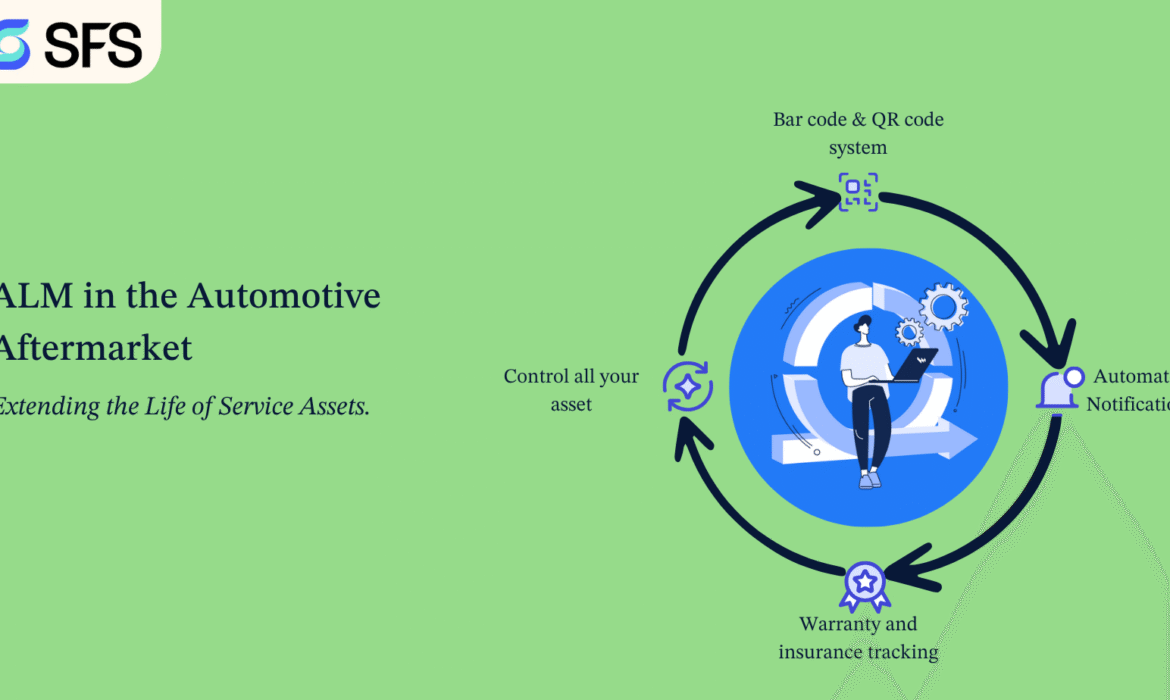
Control all your asset over the entire lifecycle:
- ALM systems provide a single source of truth for tracking all parts, tools, and equipment.
- Each asset (e.g., diagnostic scanner, torque wrench, brake lathe) is tagged and monitored throughout its lifecycle.
- Real-time data helps service managers locate tools quickly and verify their availability and condition.
Predictive and Preventive Maintenance:
- ALM platforms use usage data and condition monitoring (often via IoT sensors) to forecast wear and tear.
- Instead of waiting for tools to fail, the system schedules maintenance based on actual use (e.g., number of cycles, vibration levels).
- Extends the life of tools and avoids costly emergency downtime.
Bar code & QR code system:
- With barcode or QR code scanning capabilities, it becomes easy to scan assets and retrieve up-to-date information, reducing the need for manual record-keeping and minimizing errors.
- Smart ALM uses a barcode and QR code system to identify assets and access their full maintenance, warranty, and repair history.
Lifecycle Cost Management:
- ALM systems track total cost of ownership (TCO), including purchase cost, maintenance, repairs, and downtime.
- Helps determine the right time to repair, refurbish, or replace tools or parts.
- Prevents over-investment in aging or inefficient equipment.
Regulatory Compliance and Safety:
- ALM automates tracking of inspection dates, safety checks, and compliance documentation (e.g., OSHA, EPA).
- Alerts managers before tools go out of spec or become non-compliant.
- Reduces liability and enhances workshop safety standards.
Conclusion: Smart ALM transforms how automotive service centre’s manage aftermarket parts and tools—from manual tracking and reactive maintenance to intelligent lifecycle optimization. It delivers measurable gains in efficiency, cost savings, reliability, and compliance, all of which are critical to remaining competitive in the modern automotive aftermarket.
End with a clear next step: Are you ready to upgrade your Asset Lifecycle Management processes and take your business to new heights? Contact Smart Factory Solutions today and learn how we can be tailored to meet your specific needs. Our team is eager to provide personalized recommendations and demonstrate how our solutions can move your business forward. Contact us now and take the first step toward achieving exceptional quality and customer satisfaction.