
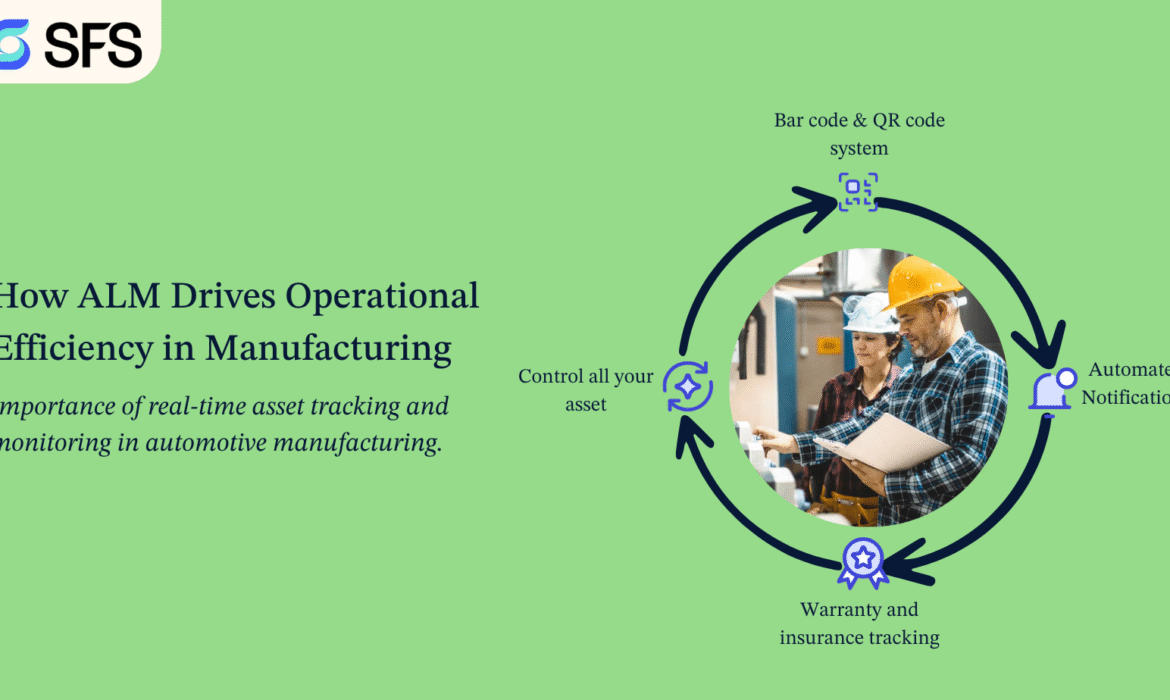
The automotive business is made up of different companies that oversee creating automobiles and other automotive products, from designing and manufacturing to marketing and selling. This operation is very large overall and needs enough personnel, plant machinery, spare parts, equipment, and facilities. Better known as assets. Asset lifecycle management (ALM) plays a key role in enhancing operational efficiency in automotive manufacturing by managing the entire lifecycle of equipment, machinery, and other assets. Here’s how ALM contributes to operational efficiency in this sector:
- Asset visibility: All assets in the manufacturing facility may be tracked and monitored in real time by ALM systems, giving managers a comprehensive picture of the locations, performance, and conditions of each asset. This helps them make better decisions.
- Forecast Maintenance: ALM systems can forecast when machinery will need maintenance or replacement by evaluating data from equipment sensors. This minimizes the chance of production delays, optimizes maintenance plans, and cuts down on unscheduled downtime.
- Better Resource Allocation: Managers may better allocate resources, optimize production schedules, and balance workloads across machines by using ALM to discover underutilized or overworked assets.
- Extended Asset Lifespan: Frequent maintenance and monitoring extend the life of vital equipment, reducing the need for expensive replacements and raising the machinery’s overall return on investment (ROI).
- Standardized Processes: By enforcing uniform asset management procedures throughout the factory, ALM guarantees uniformity in the use, upkeep, and repair of equipment, leading to more efficient operations.
- Cost Optimization: ALM assists in monitoring each asset’s total cost of ownership (TCO), accounting for acquisition, operating, and maintenance expenses. These guarantees cost effectiveness throughout the asset lifecycle and help manufacturers make better investment choices.
Streamlining automotive production with integrated ALB system.
Using an integrated ALB (Automated Load Balancing) system to streamline automobile production entails minimizing manufacturing bottlenecks, increasing resource efficiency, and streamlining the flow of production operations. An integrated ALB system helps make an automobile production line more efficient in the following ways.
Dynamic Load Distribution: Production workloads are continuously monitored by an integrated ALB system, which also assigns assignments to workstations and machines according to performance and capacity. This keeps some resources from being overloaded while making sure others aren’t underutilized.
Minimizing Bottlenecks: ALB reduces delays or blockages that usually slow down production by automatically balancing the load and rerouting work to parts of the production line with available capacity. Production flows become more consistent and fluid as a result.
Resource Optimization: By balancing workloads in real-time, ALB makes sure that resources (people, robots, machines, etc.) are used effectively, improving productivity and reducing idle time for labour and equipment.
Real-Time Adjustments: To preserve efficiency, the integrated ALB system is made to modify load distribution in real-time to production changes, such as shifts in work complexity, equipment failures, or material shortages.
Reduced Downtime: ALB reduces downtime brought on by overworked or underperforming equipment by proactively distributing the load across the production line, guaranteeing that every station runs at maximum efficiency without needless delays.
Improve Collaboration Between Systems: Integration with other systems, such Manufacturing Execution Systems (MES) or Enterprise Resource Planning (ERP), guarantees that the ALB system is in line with scheduling, logistics, and inventory management, improving the overall coordination of production processes.
Quality Control: By guaranteeing that every workstation has enough time and resources to achieve quality standards, ALB helps sustain greater product quality by minimizing production delays and irregularities in workload distribution.
The importance of real-time asset tracking and monitoring in automotive manufacturing.
The importance of real-time asset tracking and monitoring in automotive manufacturing includes the following key points.
- By reducing downtime and guaranteeing that machines are always ready for production when needed, real-time tracking guarantees that assets are used as efficiently as possible.
- Real-time asset performance monitoring enables predictive maintenance, which lowers unplanned downtime and unexpected breakdowns by enabling early problem discovery.
- Real-time asset tracking guarantees that all assets adhere to safety and industry standards by providing traceability for audits and regulatory compliance.
- By knowing the availability and condition of important assets, real-time data helps improve production schedule planning by cutting down on delays and boosting throughput.
- Based on real-time data, managers are able to make well-informed decisions and modify asset management procedures and production workflows to meet pressing demands.
- Real-time monitoring contributes to cost savings by preventing asset failure and decreasing downtime, which in turn reduces maintenance, repair, and production delays.
- Dynamic resource allocation made possible by real-time data guarantees that resources are allocated to the appropriate tasks according to their availability and performance at any given time.
- Maintaining the quality and consistency of the automotive products being produced requires constant monitoring to make sure assets are operating as expected.
- Real-time tracking of the location and state of tools and equipment improves supply chain efficiency by lowering overstocking and inventory shortages.
- Quick reactions to issues are made possible by immediate asset status visibility, which reduces production interruptions and maintains the manufacturing process’s momentum.
How ALM helps automakers manage machinery, production lines, and vehicles more efficiently.
Because it streamlines operations and promotes smooth integration across the manufacturing lifecycle, Application Lifecycle Management (ALM) is essential for automakers as it improves the effectiveness of controlling equipment, production lines, and automobiles. These are its main advantages:
Management of Machinery and Equipment:
- Maintenance and Monitoring: ALM tools can be used to schedule maintenance, monitor the operation of machinery, and offer insights into possible breakdowns. Automakers are able to reduce downtime and increase overall production by anticipating when machinery requires maintenance through predictive analytics and data management.
- Optimization of Resources: ALM guarantees that assets are used effectively by controlling the lifecycle of machinery, from installation to retirement. This prevents underutilized equipment or overutilized resources, which can result in failures.
Production Line Management:
- Streamlining the Workflow: ALM integrates procedures, hardware, software, and other elements of the manufacturing line. This makes it possible for automakers to guarantee efficient processes, reduce bottlenecks, and prevent production delays.
- Change Management: ALM makes it easier to handle modifications to production lines and equipment. For example, ALM solutions guarantee that updates are applied uniformly throughout the system in the event of a change in production technology or design.
Vehicle Development and Management:
- Design and Prototyping: Vehicle design in the automotive sector is extremely complicated and necessitates the management of substantial volumes of data from test results, engineering specifications, and CAD models. By providing version control, traceability, and communication tools, ALM facilitates process optimization and guarantees that design iterations are efficiently managed.
- Quality Control: ALM incorporates quality control procedures into the manufacturing of automobiles. Automakers can use ALM to track flaws, keep an eye on testing, and guarantee adherence to safety regulations from the development phase to final assembly. This lessens the chance of expensive mistakes or product recalls.
- Software and Embedded Systems: Software and embedded technologies play a major role in modern automobiles. From development to deployment and maintenance, ALM assists automakers in managing the lifetime of in-vehicle software, guaranteeing that security patches and regular upgrades are implemented as required.
End-to-End Traceability: ALM offers complete visibility into all phases of vehicle development and manufacture. This covers monitoring design modifications, sourcing of parts, manufacturing processes, and post-production upkeep. Automakers may enhance decision-making and cut down on delays caused by information silos by connecting data across many teams.
Sustainability and Environmental Impact: ALM assists automakers in tracking how their production processes affect the environment. Automakers can reduce their carbon footprint by optimizing production processes and working towards sustainability goals by gathering data on waste output, emissions, and resource utilization.
Supply Chain Integration: Automakers can better connect their supply chains with the use of ALM solutions. Automobile manufacturers can lower costs, increase components availability, and better adapt to shifting demand by integrating production schedules with suppliers and inventory management systems.
Conclusion: By offering complete management, fostering collaboration, optimizing resource utilization, guaranteeing compliance, and facilitating ongoing improvements throughout the automotive manufacturing process, ALM essentially increases the efficiency of equipment, production lines, and automobiles. It encourages more intelligent decision-making and lowers risks, which eventually results in lower costs and higher-quality products.
End with a clear next step: Are you ready to upgrade your ALM (Asset Lifecycle Management) processes and take your business to new heights? Contact Smart Factory Solutions today and learn how we can tailor it to meet your specific needs. Our team is eager to provide personalized recommendations and demonstrate how our solutions can move your business forward. Contact us now and take the first step toward achieving exceptional quality and customer satisfaction.


