
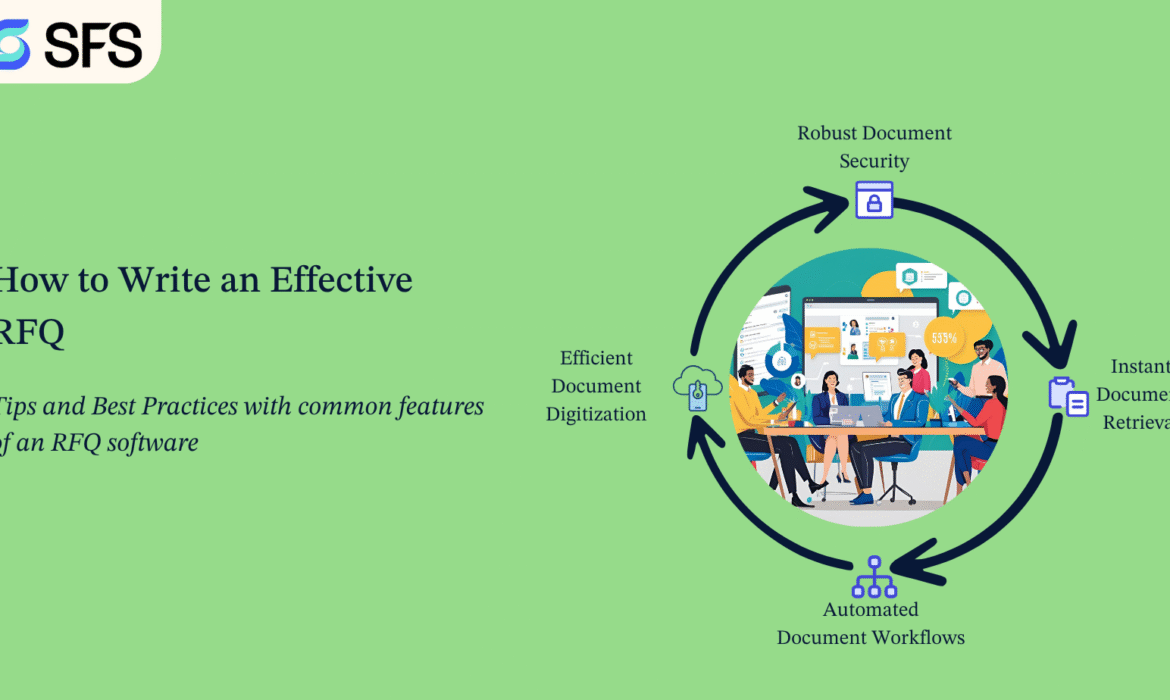
Effective procurement procedures are essential for preserving cost control, guaranteeing quality and cultivating solid supplier relationships in the cutthroat corporate environment of today. Request for Quote (RFQ) software is one effective technique that can greatly improve your procurement approach. We’ll learn how to write an effective RFQ in this blog post. We’ll also go over tips and best practices in this blog post.
Tips and Best Practices for Writing Effective RFQs: To get precise and competitive quotations from suppliers, make sure you get the most for your money and reduce misunderstandings, it is essential to write an efficient Request for Quotation (RFQ). The following advice and best practices will help you write an extensive and successful RFQ:
- Describe exactly what goods, services, or labour you require. Inaccurate bids result from vague descriptions. Provide explicit requirements, amounts and anticipated results.
- To prevent misunderstandings, use industry-standard phrasing when requesting technical specifications. This will make it clearer to possible vendors what you need.
- List materials, dimensions, sizes, models and other important details. And list any non-negotiable requirements that bidders must meet to be considered.
- Give a thorough explanation of any quality requirements you may have (such as certifications or regulatory compliance).
- Include any performance expectations, warranties, or guarantees for the product or service.
- Establish precise delivery and deadline expectations, including the due date for RFQ submission, the anticipated date of delivery or completion and any interim checkpoints or milestones.
- Clarify payment expectations, such as deposit requirements, milestones, or payment on delivery.
- Provide information on whether taxes or other fees are included in the price or will be added separately, as well as the currency in which the quote should be made.
- Ask for details about the bidder’s company, including references, financial soundness, certifications and licenses.
- Describe the fundamental conditions that will control the supplier relationship, such as non-disclosure agreements (NDAs), confidentiality agreements and intellectual property rights.
What are the common features of an RFQ software?
Request for Quotation (RFQ) software automates and manages RFQs, which helps to expedite the procurement process. Typical RFQ software features include:
Seamless RFQ Creation:
- Enables users to use common formats to swiftly construct RFQs.
- Generate detailed RFQs effortlessly, saving time and ensuring accuracy.
- Companies can modify RFQs to add fields such product descriptions, quantities, terms of delivery and cost information.
- Permits procurement teams to simultaneously draft several RFQs for various goods or vendors.
Centralized Supplier Information:
- Keeps track of approved vendors’ contact information, performance history and pricing information.
- Based on preset parameters, the system can automatically submit RFQs to chosen vendors.
- Manage supplier data in one centralized platform for streamlined communication.
- Allows suppliers to log in, view RFQs and submit their bids directly.
Bid Collection & Evaluation:
- For ease of comparison, all supplier responses are gathered in one location.
- Predetermined evaluation criteria, such as cost, delivery time and quality, can be used by the software to provide ratings.
- To make well-informed selections, users can compare quotes from several suppliers at once.
- Smart RFQ lets us easily collect and evaluate bids.
Secure Quote Privacy:
- Through role-based access guarantees, only permitted individuals can view specific RFQs or supplier data.
- Protect sensitive information with secure login and access controls.
- assists companies in adhering to industry-specific compliance requirements including SOX, GDPR and ISO.
- Shields private procurement information from breaches or illegal access.
Automated Task Reminders:
- Ensures adherence to corporate policies by automating the internal approval process for smart RFQs.
- Stay on top of critical smart RFQ tasks and deadlines with automated reminders.
- Notifies internal teams and suppliers of impending approvals, deadlines and next steps.
- Guarantees a smooth transition from smart RFQ to the creation of purchase orders.
Advanced Reporting:
- Gives information about smart RFQ status, bidding patterns and supplier performance.
- Gain valuable insights from comprehensive reports, enabling data-driven decision-making.
- Aids companies in forecasting future procurement prices and analysing previous quotes.
- Uses historical bids, fulfilment rates and compliance to track a supplier’s dependability.
The essential components of a well-crafted RFQ: specifications, deadlines and requirements.
Having a well-written Request for Quotation (RFQ) is essential to getting precise and competitive quotes from vendors. All the information required for prospective vendors to comprehend the scope of work and reply suitably should be included in the RFQ. The following are the necessary elements to incorporate:
Specifications: Include a clear, comprehensive description of the goods or services needed. Describe any required performance criteria (e.g., durability, speed, energy efficiency). Specify any required industry standards or certifications (for example, ISO certification, safety regulations, environmental compliance).
Deadlines: For vendors to comprehend the timeframe they must work within, clear deadlines are necessary. This enables vendors to allocate their resources appropriately and helps guarantee on-time delivery. You must obtain all vendor responses by a certain date and time. This allows suppliers ample time to get their bids ready. For larger projects, provide interim deadlines for key deliverables or phases, so vendors know what’s expected along the way.
Requirements: The qualifications, deliverables and terms of the contract that you expect from vendors are described in this section. Give vendors instructions on how to break down their prices (e.g., itemised costs, project cost, per unit). Make it clear whether shipping, taxes and other expenses should be included or not. If there are any standard terms or conditions you expect vendors to adhere to, include them here. This may include confidentiality agreements, intellectual property considerations, or compliance with legal and regulatory requirements.
Conclusion: RFQ software is a potent instrument that can revolutionise your procurement procedure by improving accuracy, efficiency and teamwork. You can save a lot of money and improve your supplier relationships by selecting the appropriate software and putting it into practice well. With RFQ software, embrace the procurement of the future and set up your company for success in the cutthroat market of today. The advantages of using RFQ software greatly exceed the initial cost, although it does require careful design, training and continuous optimisation.
End with a clear next step: Are you ready to upgrade your RFQ management processes and take your business to new heights? Contact Smart Factory Solutions today and learn how we can be tailored to meet your specific needs. Our team is eager to provide personalized recommendations and demonstrate how our solutions can move your business forward. Contact us now and take the first step toward achieving exceptional quality and customer satisfaction.


