
Introduction: Smart project management software facilitates resource management, planning, and organisation for successful project execution. To guarantee a successful project completion, this solution is made to help teams and project managers keep track of assignments, deadlines, budgets and progress. In this blog, we will discuss in detail about risk management in smart project management, highlighting how to identify, assess and mitigate risk in a successful project management approach. We will also discuss key solutions that can help you create a roadmap to success.
Risk Management in Smart Project Management: To guarantee project success, risk management in smart project management is a systematic procedure that aids in risk identification, assess and mitigation. Here’s a thorough method:
Identifying Risks: Accurate risk identification entails identifying possible dangers and unknowns that could affect the project.
Methods to Identify Risks:
- Brainstorming: Engage team members to identify risks based on experience.
- SWOT Analysis: Analyse project strengths, weaknesses, opportunities and threats.
- Expert Judgment: Seek advice from stakeholders and experts.
- Historical Data: Review past projects for similar risk patterns.
- Checklists & Frameworks: Use standardized risk identification templates.
Assessing Risks: After identifying risks, evaluate their potential impact and likelihood.
Key Assessment Techniques:
- Qualitative Analysis: Use risk matrices to rank hazards according to likelihood and seriousness.
- Quantitative Analysis: For an accurate evaluation, use numerical methods such as Expected Monetary Value (EMV) or Monte Carlo simulations.
- Risk Categorization: Classify risks (e.g., technical, operational, financial, external).
- Risk Register: Maintain a document listing risks, their impact and response strategies.
Mitigating Risks: Creating plans to reduce risks and increase possibilities is known as risk mitigation.
Common Mitigation Strategies:
- Avoidance: Reduce high-risk activities by changing the goals or scope of the project.
- Mitigation: Reduce the impact by taking proactive steps (e.g., more training, better resource allocation).
- Transfer: Shift risk responsibility to third parties (e.g., insurance, outsourcing).
- Acceptance: Prepare contingency plans for unavoidable risks.
Case studies on how organizations are using project management software to manage projects.
A manufacturing company needed a flexible project management solution to support rapid innovation, production scaling, and continuous improvement in their factories. The company adopted project management tools to manage its rapid manufacturing processes. Key benefits include:
- Promote teamwork and communication across departments and locations.
- Automate updates, tasks, and reminders to ensure optimal project execution.
- Make data-driven choices to efficiently manage risks and distribute resources.
- Use a single source to access project documentation, templates, and forms.
- Customise reports to obtain an in-depth understanding of different project components.
Key outcomes of the smart project management lifecycle.
Despite early difficulties, the project benefited from proactive risk management:
✅ Predictive maintenance can cut IoT failures by 37%.
✅ Stop security breaches by keeping an eye on things in real time.
✅ Keep budget deviation within 5% of the planned cost.
✅ Gain public acceptance, with 75% approval rates after privacy measures were strengthened.
Extensive smart project management features.
Utilise the sophisticated features of SFS Smart PM to enhance your manufacturing initiatives. Enhance teamwork, automate processes, and guarantee effective project management.
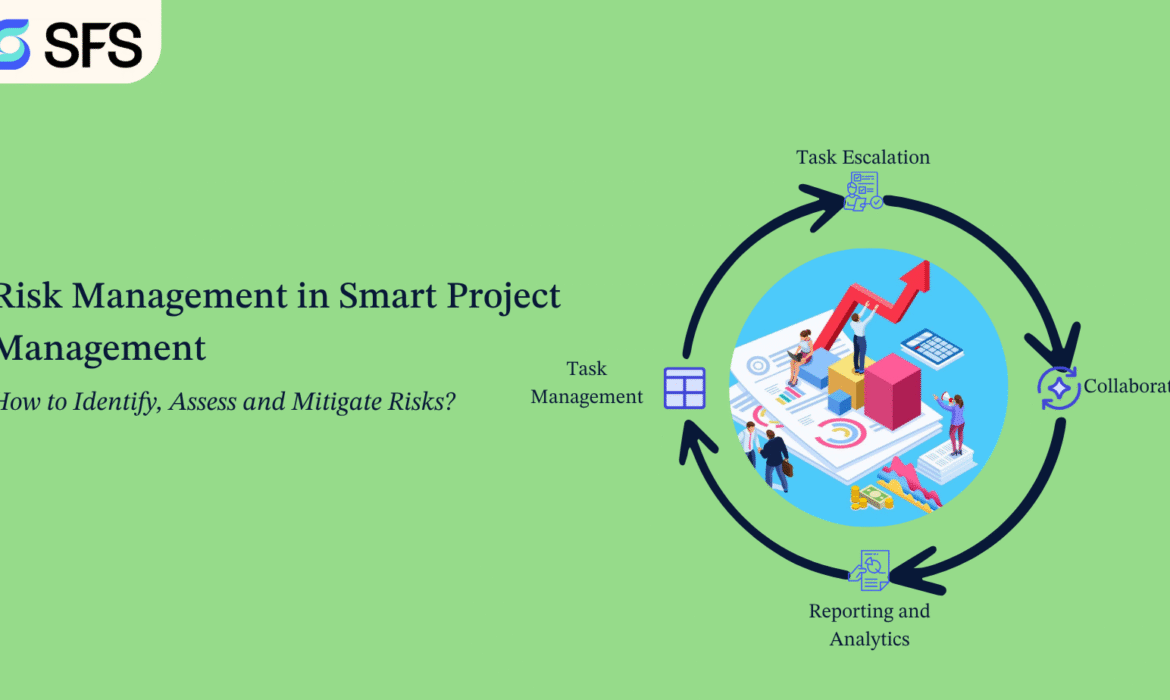
Task Management: Any successful project is built on a foundation of efficient task management. This feature makes sure that everyone is aware of their responsibilities, how to avoid bottlenecks and how to maintain the project’s timeline. This tool makes planning and prioritisation easier than ever by providing a clear picture of what lies ahead.
Collaboration: When everything is centralised, collaboration is smooth. When team members have access to an intelligent project management system, they can communicate in real time, share files and provide and receive feedback. Everyone remains linked thanks to the integrated collaboration tools. Collaboration is improved and misunderstandings are reduced when all information, including documents and conversations, is kept in one location.
Task Escalation: Task escalation is used when certain tasks require greater attention than others. Tasks that are behind schedule or need greater priority attention are highlighted by intelligent project management software. A task is moved up the chain for prompt attention when it is escalated. This function keeps projects on track and assists in resolving possible obstacles before they become significant issues.
Reporting and Analytics: Detailed reports on task completion, resource utilisation, budget performance and other topics can be produced using reporting and analytics tools. You can make well-informed decisions based on real-time insights by using the analytics to assess the project’s status. Additionally, customisable reports enable you to concentrate on the indicators that are most important to your organisation.
Gantt Charts: For displaying the project timeline and task relationships, Gantt charts are a crucial tool. Gantt charts, which are a feature of project management software, provide a clear, visual depiction of the relationships between tasks and their due dates.
Role-Based Dashboards: Not all team members require the same data. Project management software offers individualised views that are catered to each user’s unique requirements through role-based dashboards.
Conclusion: To efficiently control risks, smart project management combines technology, proactive planning and teamwork. Project managers may enhance decision-making, guarantee project success and preserve resilience in unpredictable situations by methodically identifying, evaluating and managing risks.
End with a clear next step: Are you ready to upgrade your Project Management processes and take your business to new heights? Contact Smart Factory Solutions today and learn how we can be tailored to meet your specific needs. Our team is eager to provide personalized recommendations and demonstrate how our solutions can move your business forward. Contact us now and take the first step toward achieving exceptional quality and customer satisfaction.


