
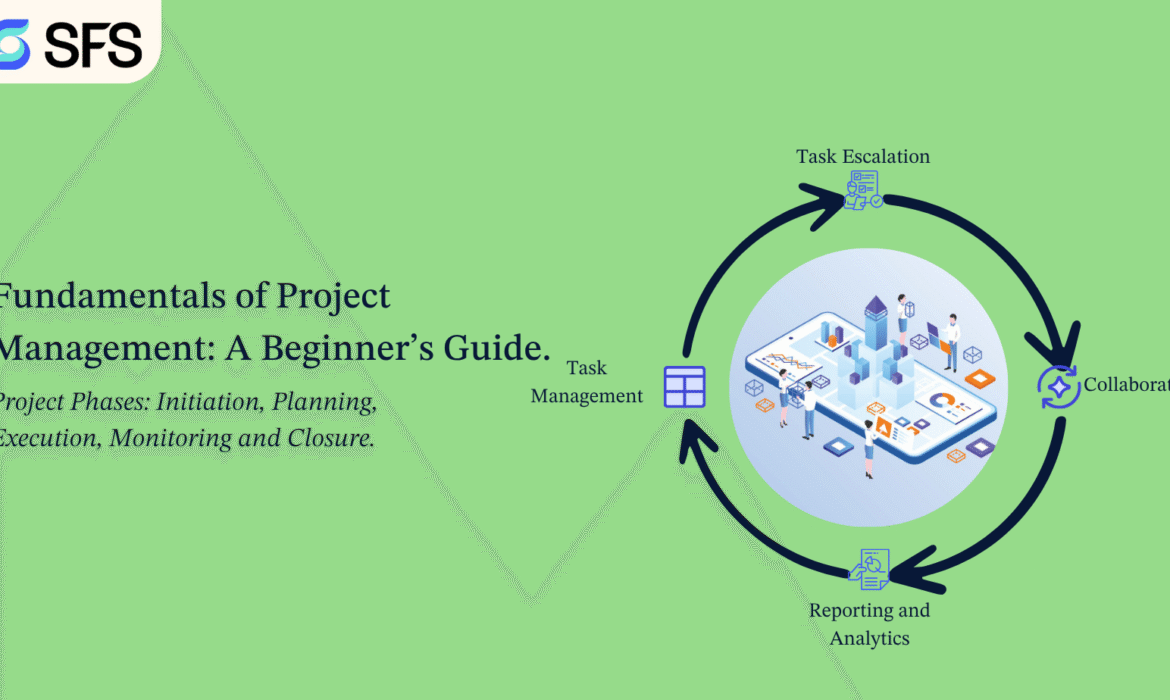
To accomplish objectives within a predetermined timeframe, project management entails organizing, planning, and carrying out initiatives. It can be used in a variety of industries, including software development and construction. This is an introduction to the fundamental ideas of project management.
What is Project Management?
The process of applying tools, techniques, knowledge, and skills to project activities to achieve project requirements is known as project management. To complete a project on schedule, within scope, and within budget entails managing risks, resources, and finances.
Skills Required for Project Managers:
- Guiding and motivating the team to achieve their project goals.
- Encouraging open, honest communication and informing all parties involved.
- Managing deadlines and ensuring tasks are completed on schedule.
- Recognizing and resolving problems that come up throughout the process.
- Balancing the interests of stakeholders and securing necessary resources.
Key Principles in Project Management that every project manager should know.
Key Principles of Project Management: A project typically involves the following principles.
- Project Scope: Project management describes the aims, objectives, deliverables, and results of the project. It helps prevent “scope creep,” which is the addition of new duties without sufficient supervision.
- Project Timeline: Detailed timelines of when tasks and milestones should be completed in project management. This is essential for managing deadlines and ensuring timely delivery.
- Budget: The budget shows how much labor, materials, and other resources are expected to cost. It assists in making sure the project stays within the allocated budget.
- Resources: The human, physical, and technical resources needed to complete the project.
- Quality: Ensuring that the project satisfies the expectations of the stakeholders and the requirements.
- Risk Management: Recognizing and controlling possible hazards that can compromise the project’s success.
Overview of Project Phases: Initiation, Planning, Execution, Monitoring, and Closure.
The Project Management Phases: Project management typically follows a set process, often structured in five phases:
- Initiation: Develop a project charter and define the project’s objectives, scope, and stakeholders. This is where the need for the project is identified, and the feasibility of the project is assessed. The project charter was created to formally authorize the project.
- Planning: Create a detailed project plan, including timelines, budgets, resource allocation, and risk management strategies. Here, the necessity of the project is determined, and its viability is evaluated. The project is formally authorized by the creation of a project charter.
- Execution: This stage marks the start of the real job. To accomplish the project’s goals, team members collaborate, assign resources, and complete tasks. The project manager keeps tabs on developments, resolves problems, and interacts with stakeholders.
- Monitoring: This stage makes sure the project stays on course and continues alongside the execution phase. Performance is monitored, and if required, remedial measures are implemented. This entails managing modifications and comparing progress to the plan.
- Closure: The project is officially closed after it is finished. To learn from the project’s accomplishments and shortcomings, this entails delivering the finished product to the client, releasing project resources, and carrying out a post-project evaluation.
Common Terminology and Frameworks used in the Field of Project Management.
Key Terminology in Project Management:
- Project Management: Applying information, abilities, instruments, and methods to project tasks to fulfil project specifications and provide the intended outcomes.
- Stakeholders: People or groups actively participating in the project or whose interests could be impacted by its conclusion.
- Timeline: A thorough plan that specifies the due dates for project assignments. It comprises task dependencies, deadlines, and milestones.
- Resources: The personnel, materials, equipment, and financial capital needed to complete a project.
- Quality Management: Ensuring that the deliverables of the project fulfil the necessary quality requirements. Planning, ensuring, and controlling quality are all included in this.
- Project Charter: A formal document that gives the project manager the power to allocate resources to project activities and validates the project’s existence.
- Project Lifecycle: The series of phases that a project goes through from initiation to completion. These phases typically include initiation, planning, execution, monitoring and controlling, and closure.
- Milestones: Important events or turning points in the project lifecycle that indicate advancement or the accomplishment of important tasks.
- Change Management: The procedure for handling modifications to the project’s resources, timetable, or scope. This guarantees that any modifications are evaluated, accepted, and successfully put into effect.
Project Management Frameworks:
- PMBOK (Project Management Body of Knowledge): The Project Management Institute (PMI) created the PMBOK, which offers a set of accepted terms and project management best practices. Initiation, planning, execution, monitoring & controlling, and closing are the five process groups it includes. Integration, scope, time, cost, quality, human resources, communications, risk, procurement, and stakeholder management are among the other knowledge domains that are included.
- PRINCE2 (PRojects IN Controlled Environments): A methodical, process-based approach to project management. It places a strong emphasis on distinct project responsibilities, stages, and control methods, and is widely utilized in the UK and Europe. Delivering business value is the main purpose of PRINCE2, which also makes sure the project stays in line with corporate objectives.
- Agile: Software development frequently employs an incremental and iterative approach to project management. Agile uses brief development cycles, or sprints, to encourage adaptability, teamwork, and customer-focused delivery. Agile frameworks include Extreme Programming (XP), Scrum, and Kanban.
- Scrum: A well-liked Agile framework that is mostly applied to software development. Scrum prioritizes ongoing feedback, teamwork, and improvement while dividing work into smaller, more manageable units called sprints. The Development Team, Scrum Master, and Product Owner are all Scrum roles.
- Lean: A strategy aimed at increasing value through process improvement and waste elimination. Toyota Production System was its birthplace, and it has since been modified for use in several sectors, including software development (Lean Software Development).
- Six Sigma: A data-driven approach to finding and fixing flaws in processes to improve their quality. Six Sigma employs DMADV (Define, Measure, Analyse, Design, Verify) for process design and DMAIC (Define, Measure, Analyse, Improve, Control) for process improvement.
- Waterfall: A traditional, linear project management methodology where each phase is completed before moving on to the next. Waterfall is best suited for projects with well-defined requirements and little scope for changes.
- Critical Path Method (CPM): A method for figuring out the longest chain of interdependent jobs in a project, which determines how short it can be. It assists in determining which tasks need to be finished on schedule in order to prevent project delays.
- Critical Chain Project Management (CCPM): Resource limitations are incorporated into the planning process via CCPM, an extension of the Critical Path Method. Its main goal is to guarantee that vital resources are available when needed and are not over-allocated.
- Earned Value Management (EVM): This method compares the actual progress (Earned Value) and cost (Actual Cost) to the expected progress (expected Value) to assess the performance of a project. This aids in forecasting project results and monitoring schedule and cost performance.
- KPI (Key Performance Indicators): Metrics for assessing a project’s or its constituent parts’ success. Cost, time, scope, quality, and stakeholder satisfaction are all possible KPIs.
- PMI Talent Triangle: PMI created a framework that places an emphasis on the ongoing improvement of project management abilities. Technical project management, leadership, and strategy and business management are its three main components.
Conclusion: The dynamic profession of project management necessitates a combination of leadership, flexibility, and strategy. New project managers can establish a strong basis to successfully negotiate the challenges of project management by comprehending its foundations. Understanding these fundamentals will help you succeed in any project, whether you’re managing a small team or a large one.
End with a clear next step: Are you ready to upgrade your project management processes and take your business to new heights? Contact Smart Factory Solutions today and learn how we can be tailored to meet your specific needs. Our team is eager to provide personalized recommendations and demonstrate how our solutions can move your business forward. Contact us now and take the first step toward achieving exceptional quality and customer satisfaction.


