
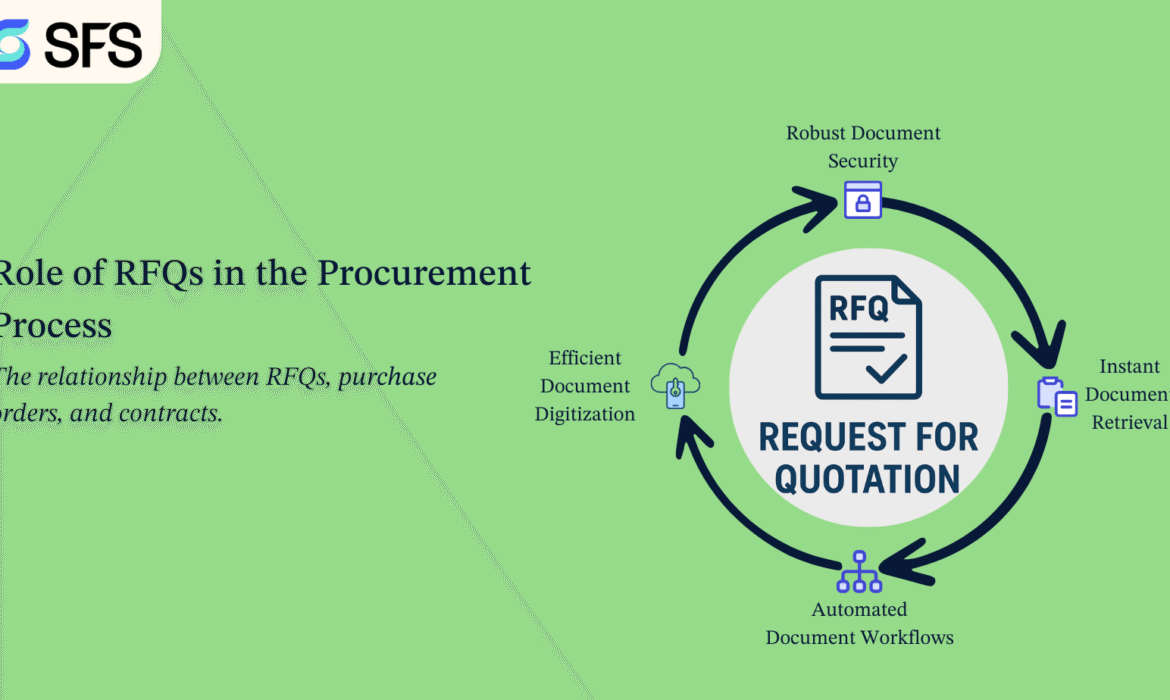
Introduction: In today’s cutthroat business environment, maintaining cost control, guaranteeing quality, and cultivating solid supplier relationships all depend on efficient procurement practices. Requesting quotations (RFQ) software is a helpful tool that can significantly improve your procurement approach. In this blog post, we will discuss the role of RFQ in the procurement process from request to purchase order. And we will learn how we can achieve 77% accuracy and save 45% more time than before.
The Role of RFQs in the Procurement Process: From Request to Purchase Order:
A Request for Quotation (RFQ) is a critical step in the procurement cycle, bridging the gap between identifying a need and formalizing a purchase order. It ensures organizations acquire goods or services at the best possible terms while maintaining transparency and competitiveness.
- Initiation of the RFQ software: A specific requirement for goods or services is determined by the procurement team. Technical specifications, quantities, quality standards, delivery schedules, and terms are all included in an RFQ form. To request competitive pricing, the RFQ is issued to qualified and shortlisted vendors.
- Supplier Response and Evaluation: Quotes from suppliers include comprehensive pricing breakdowns, lead times, and requirement compliance. Responses are assessed by the procurement team based on vendor capability, pricing, quality, and delivery dependability. A comparison analysis guarantees unbiased decision-making, frequently through a bid tabulation or supplier scorecard.
- Negotiation & Clarification: Terms, including delivery dates, payment schedules, and warranty conditions, may be negotiated by procurement specialists. Technical or commercial clarifications guarantee supplier and buyer alignment.
- Supplier Selection: The most appropriate supplier is chosen based on the results of the evaluation and negotiations. To guarantee adherence to corporate policies, this phase may require internal approvals from the management, legal, or finance departments.
- Conversion to Purchase Order (PO): The RFQ is transformed into a formal Purchase Order (PO) after the supplier has been chosen. Both parties are legally bound by the PO, which specifies the quantity, price, delivery date, and contractual duties. At this point, the quotation turns into a transaction.
- Benefits of RFQs in Procurement: The advantages of Request for Quote (RFQs) software in procurement are:
- Encourages competitive pricing.
- Enhances transparency and fairness in supplier selection.
- Reduces procurement risks by ensuring suppliers meet specifications.
- Provides a clear audit trail for compliance and accountability.
Case study on the role of RFQ tool in the procurement process from request to purchase order.
A medium-sized company that manufactures vehicle parts. Their procurement team encountered delays and mistakes when manually managing supplier quotations due to rising demand and an expanding supplier base.
Implementation of Smart RFQ Tool: The organization adopted the Smart RFQ tool that automated the end-to-end procurement process.
- Achieved accuracy: The company achieved 77 % accuracy through implementation.
- Cycle Time Reduction: Procurement cycle reduced by 45% (from 10 days to 6 days).
- Cost Savings: Achieved 8% cost reduction by easily comparing supplier quotations.
- Supplier Relationship: Improved transparency and faster communication with suppliers.
The relationship between RFQs, purchase orders, and contracts.
Request for Quotation (RFQ):
- Purpose: An RFQ is a sourcing method used to solicit suppliers’ terms, prices, and availability information for specific products or services.
- Nature: This is a request for information and pricing, and it is not legally binding.
- Outcome: Helps the buyer compare suppliers and decide who to award the business to.
Purchase Order (PO):
- Purpose: A purchase order (PO) is an official offer to buy products or services from a provider at the predetermined cost, quantity, and delivery conditions.
- Nature: When accepted by the supplier, it becomes a legally binding document.
- Outcome: Gives the buyer permission to pay and the provider permission to deliver products or services.
Contracts:
- Purpose: A contract is a detailed agreement that outlines the buyer-supplier’s larger business relationship. Service standards, delivery schedules, fines, privacy, and dispute settlement are a few examples.
- Nature: Legally enforceable, encompassing strategic or long-term purchases (not just one-time purchases).
- Outcome: Provides a framework under which multiple POs may be issued.
Relationship:
- RFQ → helps identify the best supplier.
- PO → executes the purchase based on that quote.
- Contract → governs the overall relationship (especially for repeated or large-scale purchases).
Conclusion: The adoption of an RFQ tool transformed ABC Manufacturing’s procurement process from a manual, time-consuming activity to a streamlined, transparent, and cost-efficient workflow. By automating the journey from request to purchase order, the company gained better supplier collaboration, improved compliance, and faster decision-making – ultimately supporting production efficiency and business growth.
End with a clear next step: Are you ready to upgrade your RFQ Management processes and take your business to new heights? Contact Smart Factory Solutions today and learn how we can be tailored to meet your specific needs. Our team is eager to provide personalized recommendations and demonstrate how our solutions can move your business forward. Contact us now and take the first step toward achieving exceptional quality and customer satisfaction.


