
Introduction: Businesses in a wide range of sectors rely significantly on a range of resources to function effectively and stay competitive in the ever-changing business environment of today. Organisations use asset lifecycle management (ALM) techniques to guarantee compliance, cost effectiveness and peak performance. This blog post will discuss the impact of ALM on automotive supply chain management, as well as how downtime can be reduced by up to 23% and maintenance costs can be reduced by up to 33%.
Impact of ALM on automotive supply chain management: By guaranteeing the effective use of assets throughout their existence, asset lifecycle management or ALM, is essential to improving automotive supply chain management (SCM). The following are some ways that ALM affects SCM in the automotive sector:
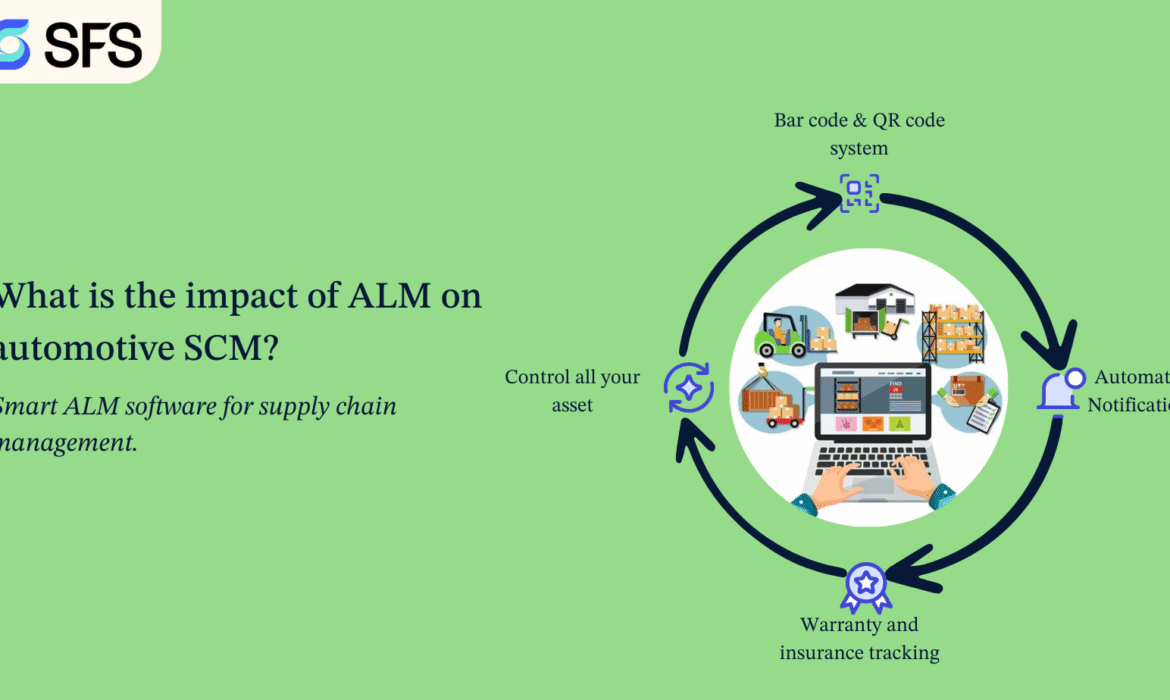
- Take control of all your assets with Smart ALM’s extensive management features during their whole lifecycle.
- Smart ALM assists in monitoring and controlling the use of vital resources (such as fleets, tools and machinery) to avoid overuse or underuse.
- To identify assets and retrieve their complete maintenance, warranty and repair history, Smart ALM employs a barcode and QR code technology.
- Predictive and preventative maintenance are made possible by ALM implementation, which lowers unplanned breakdowns. This improves supply chain dependability, reduces manufacturing delays and lowers repair costs.
- ALM reduces capital expenditures on new equipment by prolonging asset lifespans through efficient maintenance.
- Government rules pertaining to waste management, emissions and car production are better followed.
- Software-driven systems are a major component of modern cars. Reliability is increased by ALM’s smooth integration of hardware and software components across various supplier tiers.
- Better supply chain resilience results from ALM’s reduction of time-to-market and management of manufacturing costs through increased transparency, automation and efficiency in development and logistics.
- Every component, software module and requirement can be traced throughout its lifecycle thanks to ALM’s end-to-end traceability. This facilitates defect monitoring and expedites the settlement of issues.
- Your assets’ warranties and insurance are tracked by Smart ALM, which also assists in managing coverage information, expiration dates and decisions regarding claims or renewals.
Case study on how organizations benefit from Smart ALM software for supply chain management.
A large manufacturing company’s supply chain was inefficient because of underutilised assets. They had trouble keeping track of how often the equipment was used, which frequently led to idle equipment and needless purchases.
With smart asset lifecycle management software: The business was able to see how its assets were being used. They were able to monitor idle time, utilisation rates and asset performance using real-time data from IoT sensors integrated into the apparatus.
Outcome: The company reduced downtime by 23% and maintenance costs by 33%, as proactive maintenance allowed them to address potential issues before they led to failures. This improved delivery efficiency, reduced operational disruptions and enhanced customer satisfaction.
How Asset Lifecycle Management ensures smoother logistics and material handling in automotive production?
By increasing productivity, decreasing downtime and optimising asset utilisation, Asset Lifecycle Management (ALM) is essential to facilitating more seamless logistics and material handling in the automotive industry. The following are some ways that ALM helps the automotive sector:
- Optimized Equipment Utilization: Monitors the use of vital logistical equipment, including automated guided vehicles (AGVs), forklifts and conveyors, to optimise efficiency. This guarantees that resources are distributed efficiently, preventing overuse or underutilisation.
- Predictive Maintenance & Reduced Downtime: Predictive maintenance and condition-based monitoring are used to stop unplanned malfunctions. guarantees that material handling machinery runs as efficiently as possible, avoiding delays in production.
- Efficient Inventory & Supply Chain Management: Allows for the tracking of components, raw materials and completed goods in real time. ensures that parts are delivered to the assembly line just in time (JIT), which reduces bottlenecks.
- Cost Reduction & Extended Asset Life: Lowers operating expenses by preventing premature equipment replacement and guaranteeing timely maintenance. prolongs the life of vital handling and logistics equipment, maximising capital expenditures.
- Data-Driven Decision-Making: Analyses asset performance, forecasts faults, and streamlines procedures using information from IoT and AI. enhances the decision-making process for replacing, maintaining and purchasing assets.
- Enhanced Productivity & Automation: Incorporates robotic arms, intelligent conveyors and automated storage & retrieval systems (AS/RS) into material handling automation. minimises manual intervention, resulting in logistical processes that are quicker and error-free.
Conclusion: Automotive supply chains become more robust, economical and sustainable with the use of Asset Lifecycle Management. It is an essential tactic for supply chain success since it helps manufacturers to decrease downtime, increase productivity and boost overall profitability.
End with a clear next step: Are you ready to upgrade your Asset Lifecycle Management processes and take your business to new heights? Contact Smart Factory Solutions today and learn how we can be tailored to meet your specific needs. Our team is eager to provide personalized recommendations and demonstrate how our solutions can move your business forward. Contact us now and take the first step toward achieving exceptional quality and customer satisfaction.


