
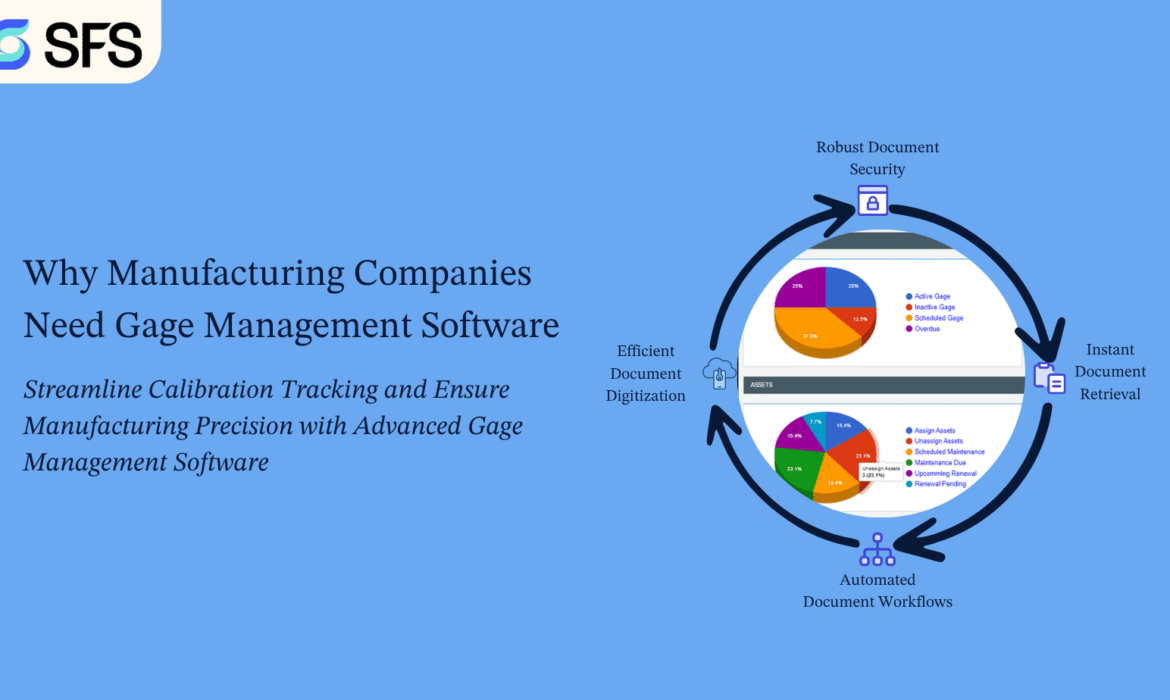
Precision, quality, and compliance are essential in modern manufacturing for successful operations. All shop-floor measuring instruments, inspection equipment and calibration devices have an effect on product quality and production accuracy. If they are not organized in a way that ensures the correct monitoring and management of the assets, manufacturers are frequently exposed to quality deviations, audit failures, production delays and higher operation costs.
This is where Gage Management Software for Manufacturing Industry becomes essential.
A digital gage management solution can support manufacturers to automate their calibration schedules, monitor measurement equipment, keep compliance files and ensure that all inspection tools are performing correctly during their lifecycle.
What is Gage Management Software?
Gage Management Software is a single application for all calibration activities, inspection instruments, measuring devices and quality control equipment for manufacturing operations.
The software package allows the manufacturers to:
⦁ Track calibration schedules
⦁ Keeping track of gage use and history
⦁ Maintain audit-ready documentation
⦁ Minimize human tracking errors
⦁ Improve equipment reliability
⦁ Make sure products are in accordance with industry standards
All tools can be tracked on a single platform, from micrometers and calipers to complex measuring instruments.
Why Manufacturing Companies Need Gage Management Software?
1. Improve Product Quality and Accuracy
Precision measurement is a crucial tool in manufacturing environment. A small error in the calibration can result in faulty products, downtime, customer complaints, or non-compliance.
Using Manufacturing Calibration Software ensures that all measuring instruments remain accurate, verified, and ready for production use.
Benefits include:
⦁ Reduced dimensional errors
⦁ Improved inspection accuracy
⦁ Better product consistency
⦁ Lower rejection rates
2. Enhance the quality and accuracy of products.
The measurements directly affect manufacturing quality. Production teams can be inadvertently producing non-conforming product if gages are not calibrated properly.
With the use of Manufacturing Calibration Software, all measuring instruments are kept in the correct state of accuracy, verified and ready for use in production.
Benefits include:
⦁ Reduced dimensional errors
⦁ Improved inspection accuracy
⦁ Better product consistency
⦁ Lower rejection rates
3. Automate Calibration Tracking
As manufacturing operations expand, tracking increases with manual entry into spreadsheets/paper records.
A digital calibration system does the following:
⦁ Calibration reminders
⦁ Due-date alerts
⦁ Asset tracking
⦁ Maintenance scheduling
⦁ Calibration history management
This will assist manufacturers to not miss their calibration deadlines and make manual processes less dependent.
4. Ensure Compliance with Industry Standards
Manufacturing industries have to meet quality standards like:
⦁ ISO 9001
⦁ IATF 16949
⦁ AS9100
⦁ FDA regulations
⦁ NABL compliance requirements
A powerful Gage Management Software for Manufacturing Industry enables businesses to keep a track of gage calibration history and create reports on the spot for audits. This enhances traceability and makes regulatory audits easier.
5. Reduce Production Downtime
Unexpected equipment failures and unavailable calibrated tools can cause disruptions to production schedules.
Automated tracking and preventive calibration management give the manufacturer the ability to:
⦁ Minimize equipment downtime
⦁ Avoiding unforeseen calibration failures
⦁ Improve maintenance planning
⦁ Increase operational efficiency
The software offers visibility of the situation of the equipment, thus assisting teams in making their planning.
6. Make Measurement Equipment Management Centralized
There may be hundreds or thousands of inspection instruments in use throughout the manufacturing environment, across departments and sites.
A central gage management system aids:
⦁ Keep calibration records in electronic format
⦁ Track gage locations
⦁ Monitor tool assignments
⦁ Manage calibration vendors
⦁ Standardize quality processes
This means there is greater control over measurement assets throughout the organization.
7. Improve Audit Readiness
Manufacturers need accurate calibration records in a timely fashion during quality audits.
If there is no system in place, finding records will be difficult and tedious.
The Best Gage Management Software for Manufacturing enables:
⦁ Instant report generation
⦁ Digital audit trails
⦁ Calibration certificates management
⦁ Historical equipment tracking
⦁ Automated documentation
This will help prepare for audits significantly.
8. Enhance Traceability Across Operations
In today’s manufacturing world, traceability is a must.
Gage management software allows manufacturers to trace:
⦁ Which gage was used
⦁ On the days that calibration was conducted. On the days of calibration.
⦁ Who was responsible for the approval of the calibration?
⦁ Which products did they inspect? What kind of products did they inspect?
This traceability enhances the quality assurance and aids in root cause analysis of quality investigations.
Key Features of Modern Manufacturing Calibration Software
Today’s calibration management systems provide the following advanced features:
⦁ Automated calibration scheduling
⦁ Barcode and QR integration capabilities. QR code and barcode integration.
⦁ Real-time equipment tracking
⦁ Calibration certificate storage
⦁ Preventive maintenance tracking
⦁ Multi-location asset management
⦁ Reporting and analytics for audits.
⦁ Cloud-based access
⦁ User role management
⦁ Integrating ERP with QMS.
The features enable manufacturers to organize their quality work and enhance efficiency. The industries that benefit from gage management software are various.
Industries That Benefit from Gage Management Software
Adopting the correct calibration and inspection accuracy is of great significance to many industries, such as:
⦁ Automotive Manufacturing
⦁ Aerospace & Defense
⦁ Industrial Machinery
⦁ Electronics Manufacturing
⦁ Medical Device Manufacturing
⦁ Precision Engineering
⦁ Heavy Equipment Manufacturing
⦁ Tool & Die Industries
In these sectors, calibration accuracy directly affects the quality of the product and compliance to regulations.
Why Digital Calibration Management is the Future?
With the transition of manufacturing to Industry 4.0 and smart factory projects, digital quality management becomes more and more significant.
There is a need to supplement traditional manual tracking methods for:
⦁ Large-scale manufacturing operations
⦁ Multi-plant environments
⦁ Compliance-heavy industries
⦁ Real-time production monitoring
A digital gage management solution enables greater visibility, automation and control, and helps ensure long term manufacturing growth.
It is essential to select the most suitable gage management software utilized in the manufacturing processes.
Choosing the Best Gage Management Software for Manufacturing?
⦁ Ease of implementation
⦁ Scalability
⦁ Integration capabilities
⦁ Audit reporting features
⦁ User-friendly interface
⦁ Cloud accessibility
⦁ Compliance support
⦁ Calibration automation capabilities
The right solution should be in line with the operational needs and the quality management objectives.
Conclusion
In manufacturing industries, accurate calibration and measurement management are essential when it comes to ensuring quality of the products, minimizing operational risks, and ensuring compliance.
Using a robust Gage Management Software for Manufacturing Industry gives manufacturers the ability to automate calibration tasks, enhance traceability, minimize downtime and reinforce quality assurance operations.
With the increased connectivity and data use in manufacturing environments, the investment in the Best Gage Management Software for Manufacturing is no longer an option, but a requirement for achieving operational excellence and continued business success.