How Project Management Software Improves New Product Development (NPD) Process Efficiency
In the current competitive manufacturing landscape, quick time to market is essential to business growth and success if you want new and innovative products to succeed. But the New Product Development (NPD) process requires collaboration between several departments, intricate workflows, tight deadlines and more. If not, when manufacturing without a structured system, a lot of delays, miscommunication and project overruns could occur.
That’s where Project Management Software comes in handy. The centralized lifecycle for planning, tracking and project execution can minimize the NPD process and enhance project performance for manufacturers.
Understanding the New Product Development (NPD) Process
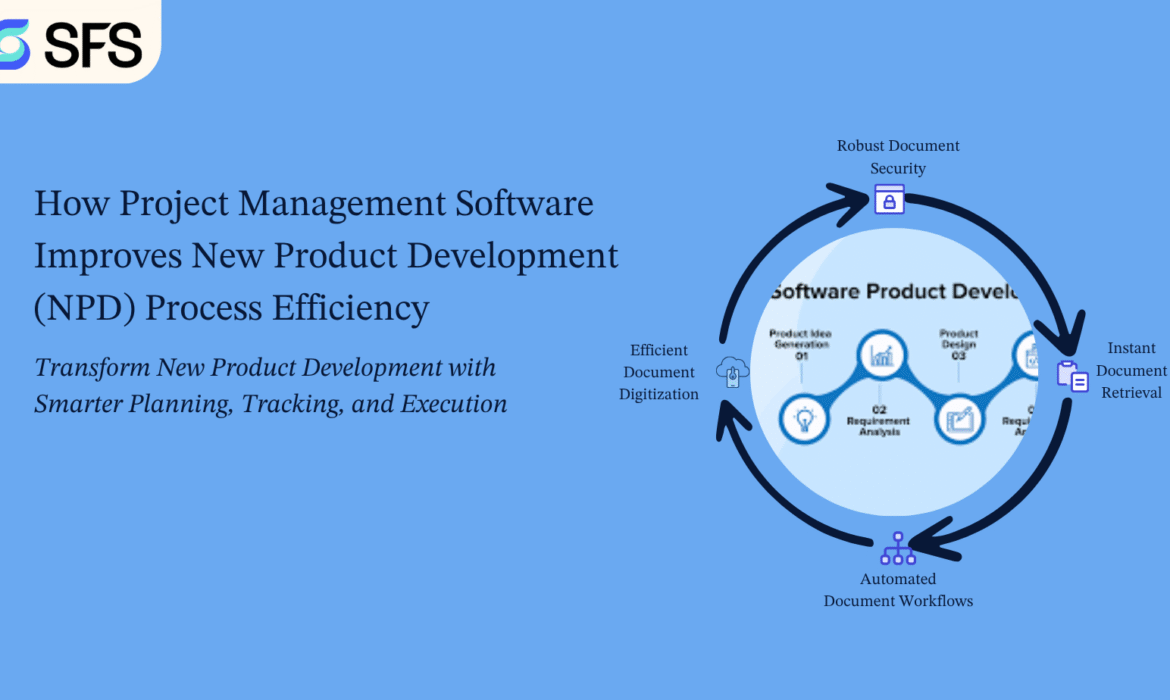
The NPD process encompasses from product concept to commercialization. It typically includes:
1. Ideas are proposed and assessed
2. Proposals for ideas are generated and evaluated
3. The design and engineering of products
4. Prototype development
5. Testing and validation
6. Production planning
7. Product launch
Different phases need a coordinated effort between the engineering, quality, production, procurement, and management teams. The lack of visibility and accountability over these activities during the project lifecycle can be challenging to manage them manually.
Some of the typical NPD Project Pitfalls are addressed. Typical NPD Project Pitfalls are addressed.
Common Challenges in NPD Projects
1. Lack of Project Visibility
It is difficult for teams to keep in touch with the status of a project, pending tasks and milestone completion across various departments
2. Communication Gaps
Email and spreadsheet communications can result in confusion, delays, and lack of updates
3. Resource Allocation Issues
Without a centralized system, managing the engineering resources, production schedule and project priorities can become increasingly challenging
4. Missed Deadlines
If there are no tracking systems in place, key project checkpoints can be missed, which can affect the launching of products.
5. Document Management Challenges
NPD projects involve a significant amount of design files, specifications, approvals and reports that must be effectively managed.
Why New Product Development Software is Important for Manufacturers
As product lifecycles become shorter and customer expectations continue to evolve, manufacturers need greater control over product development activities. A modern New Product Development Software solution helps organizations manage every stage of the development process, from concept and design to validation and launch.
By providing a centralized platform for planning, collaboration, and project tracking, it enables engineering, quality, production, and management teams to work together more effectively. This improves visibility across the product development lifecycle, reduces communication gaps, and helps ensure projects are delivered on time.
How Project Management Software Helps with the NPD Process
Manufacturers are using a new NPD Process Management Software that supports them in organizing, tracking, and managing each phase of the product development process.
Centralized Project Planning
Project managers can develop detailed project plans, make assignments, determine timelines and track progress in one place. This means that everyone referencing to the same information.
Track and monitor tasks and milestones.
Real-time project tracking with Project Tracking Software enables teams to stay informed about project milestones, task statuses, and upcoming deadlines. This enhances accountability and the chances of not having delays.
Improved Cross-Functional Collaboration
The engineering, manufacturing, quality, and procurement teams must work continuously on NPD projects. Project management software allows for departments to share information and communicate easily.
Better Resource Management
Manufacturers are able to utilize resources effectively, manage workloads and pinpoint any bottlenecks that are likely to impact on the project schedule.
Enhanced Document Control
Centralized document management will ensure that teams always have access to the latest project files, drawings, specifications and approvals.
Benefits of Project Tracking Software in Manufacturing
Project Tracking Software brings many benefits throughout the product development lifecycle.
Improved Project Visibility
Real-time dashboards offer a visual representation of project progress, task status, resource usage and milestone achievements.
Faster Decision-Making
Managers can access real information about the projects they manage and make informed decisions and react to issues as they arise
Reduced Project Delays
Automated tracking and notifications can keep project activities on track and on schedule, ensuring critical deadlines are met.
Increased Team Productivity
Teams have more time to dedicate to value-added tasks and activities, rather than handling status reports and spreadsheets.
Improve product launch performance. Enhance the performance of product launches. Better planning and execution enable organizations to meet the target time-to-market with the highest quality products.
Why Manufacturers Are Adopting Digital Project Management Solutions
This is because manufacturers are becoming more aware of Industry 4.0 and digital transformation projects and are having to adopt new ways of managing projects. As product development programs grow more complex, Modern Project Management Software can offer the visibility, collaboration and control that’s necessary.
Project planning, task management, resource allocation, and project tracking from a single source allows manufacturers to enhance their operational efficiency and ensure more predictable project results.
Conclusion
Product development is a process that demands successful planning, co-operation and execution. A Project Management Software for NPD Process for manufacturer could help them to enhance team coordination, improve workflows, and have visibility over the project lifecycle.
With state-of-the-art Project Tracking Software, companies can cut down on delays, optimize resources, and get innovative products to market.
In today’s rapidly evolving business landscape, using a modern project management solution is essential for manufacturers aiming to enhance project execution and speed up new product development.
How APQP and Manufacturing Execution System (MES) Work Together in Smart Manufacturing
Today’s manufacturing is not based on silos. To produce high quality, have real-time visibility, and process efficiency, manufacturers must have a connected ecosystem that seamlessly integrates planning and execution.
In this is where APQP (Advanced Product Quality Planning) and Manufacturing Execution System (MES) come into a pivotal role in the smart manufacturing transformation.
What is APQP (Advanced Product Quality Planning)?
APQP (Advanced Product Quality Planning) is a technique used to ensure the quality of a product or service. It is a systematic process in manufacturing to determine and design product quality requirements prior to manufacturing. It guarantees that all products are planned to meet customer expectations.
APQP includes:
1. The planning tasks for producing a product
2. Design and validation of the process
3. Failure Mode & Effects Analysis (FMEA)
4. Control plan development
5. Sizing and dimensioning (PPAP Submission)
Manufacturers can now efficiently digitize and manage this whole quality planning lifecycle with APQP Software.
What is Manufacturing Execution System (MES)?
A Manufacturing Execution System (MES) is an actual-time manufacturing administration process that keeps track of, tracks and manages manufacturing operations on the shop floor.
It connects planning systems (ERP/APQP) to the production
MES helps in:
1. Real-time production tracking
2. Work order management
3. Shop floor monitoring
4. Machine performance tracking
5. The quality control, quality assurance and quality traceability
MES Software for Manufacturing allows to execute planned processes accurately at real time.
How APQP and MES Work Together
APQP and MES are not distinct systems; rather, they are intelligent manufacturing components. APQP has been introduced to govern the things to be built and how quality should be achieved. MES is responsible for “how” that plan is implemented on the shop floor in real time.
APQP is the Manufacturing Plan defined
APQP establishes:
1. Product requirements
2. Process flow design
3. Quality checkpoints
4. Risk mitigation strategies
5. Control plans
This way, the execution of Advanced Product Quality Planning Software is structured beforehand, prior to the start of production.
2. MES Executes the Plan in Real Time
Once production starts, Manufacturing Execution System Software ensures:
a. The operators work according to the defined processes
b. Work procedures are carried out properly
c. Data is collected to monitor in-line production
d. Deviations are detected on the spot
e. Quality Assurance is observed during production
This allows to track the production in real-time and shop floor control.
3. Digital Link Between Planning and Execution
When APQP and MES are connected:
1. Mechanical drawings are directly transferred to production systems
2. Quality is checked throughout implementation
3. There are few errors and rework is significantly minimised
4. Complete traceability is ensured throughout the production process
5. This provides closed-loop manufacturing system
Benefits of Integrating APQP with MES
The benefits to manufacturers of these two systems integrated:
The product was improved for better quality consistency.
1. Real-time visibility and tracking in production
2. Decreased manufacturing defects and rework
3. New products created more rapidly
4. A more effective implementation of the IATF 16949 standard
5. New product launches that are better known and understood by various parties
6. Improved manufacturing process control
7. Improved digitalization in smart factories
To be sure, manufacturers require APQP and MES. Indeed, manufacturers need both APQP and MES. For the 4th Industrial Revolution in manufacturing, a mix of planning intelligence and execution intelligence is the key to success. APQP Software for Manufacturing is a software program that covers structured product quality planning.
MES software for manufacturing industry has the capability to ensure real time execution and control. Together, they enable:
1. Smart Manufacturing Execution
2. End-to-end process visibility
3. Higher operational efficiency
Conclusion
APQP and Manufacturing Execution System (MES) are not rival solutions, but they are two key elements of the smart manufacturing. APQP assures planning and design of quality products. MES can guarantee real-time execution and production control. Through integration, they create a robust manufacturing ecosystem that enhances efficiency, minimizes defects and facilitates the digital transformation. Smart Factory Solutions can help you to deal with these solution and provide more accurate information.